What NIO's Factory Autonomy Demo Means for Vehicle Buyers
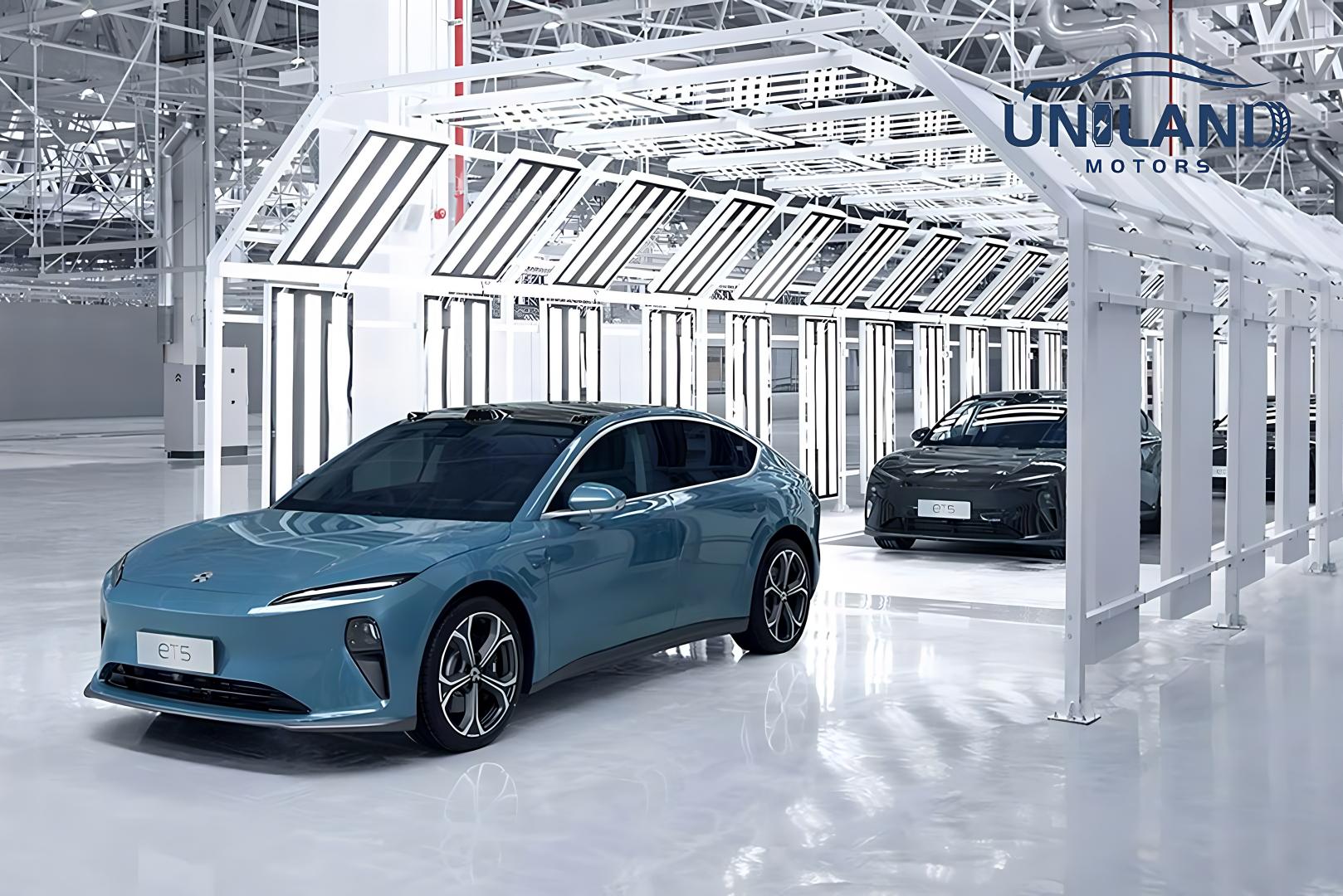
A recent NIO Technology Day demonstration showed vehicles moving autonomously inside a controlled factory environment—navigating between stations and participating in coordinated inspection procedures without a driver behind the wheel. The footage stops short of public-road autonomy, but it raises a question that matters to wholesale buyers, distributors, and procurement teams across the EV aftermarket: if vehicles can move themselves through a factory, will the way vehicles are inspected, stored, and prepared for export change with them?
Factory Autonomy and Public-Road Autonomy Are Not the Same Thing
The distinction is foundational for anyone evaluating EV sourcing.
Inside a factory, autonomous movement operates under tightly constrained conditions: designated routes, predictable zones, centralized traffic management, and a closed environment where human pedestrians and external vehicles are excluded or controlled. This is closer to a fleet coordination problem than to the open-world challenge of autonomous driving on public roads.
For B2B buyers of new energy vehicles and aftermarket parts, that difference has practical implications. Factory autonomy signals progress in internal logistics and inspection automation—it does not, by itself, mean that vehicles are ready for driverless delivery to a dealer lot or end customer. Treating the two as interchangeable is a common misunderstanding in sourcing conversations, and it can lead to inflated expectations about delivery timelines and logistics readiness.
The Real Bottleneck Is Operational Coordination, Not Vehicle Movement
Making a single vehicle drive itself from Point A to Point B is an engineering achievement. Making an entire vehicle distribution facility—or an export preparation yard—run as an intelligent, coordinated system is a different order of difficulty.
The unresolved challenges cluster around three areas:
Fleet-level task allocation. When multiple vehicles need to be inspected, charged, parked, and dispatched within the same window, the value of autonomy depends on scheduling logic that can prioritize tasks without human intervention. This is where vehicle distribution facilities and logistics centers would see the first meaningful gains—not in replacing the driver, but in reducing the dead time between process steps.
Integration with quality inspection workflows. An autonomous vehicle that can move to an inspection bay is useful only if the inspection bay can receive it, run its checks, and return a result to the system without a manual handoff. For aftermarket parts distributors and wholesale buyers evaluating supplier readiness, this kind of vertical integration inside the factory is a stronger signal of supply-chain maturity than a single autonomous demo.
Reliable safety mechanisms beyond the controlled zone. The factory environment tolerates repetition and predictability. Export yards, port staging areas, and dealer compounds introduce variables—weather, mixed traffic, irregular layouts—that the current generation of factory autonomy has not been designed to handle at scale.
Why This Still Matters to B2B EV Buyers and Parts Distributors
Even with those limits acknowledged, the direction of travel is relevant to procurement decisions.
The global EV fleet surpassed 40 million vehicles in 2025, and the independent aftermarket is entering a window where the first mass-market EVs (2017–2020 models) are reaching the age at which wear components begin to fail. Wholesale buyers and parts distributors sourcing from China are not just purchasing SKUs—they are assessing whether a supplier's upstream operations can support consistent inspection, traceability, and export readiness at volume.
If factory-level autonomous movement matures into coordinated vehicle distribution and inspection automation, the suppliers that adopt it early may gain an operational advantage in turnaround time and quality consistency. That, in turn, affects how quickly aftermarket parts can be matched, packed, and shipped alongside complete vehicles. For B2B EV sourcing teams, the question is not "when can a car drive itself to my door"—it is "which suppliers will have the operational infrastructure to keep pace when the aftermarket demand curve steepens."
What Remains Unchanged in the Supply Chain
Autonomous movement inside a factory does not eliminate the need for the capabilities that B2B buyers already depend on:
* Reliable vehicle sourcing with transparent documentation and model-configuration accuracy.
* Professional inspection that distinguishes genuine, OEM, and aftermarket components—a distinction that matters acutely in BYD parts procurement, where mislabeling aftermarket parts as genuine is a known compliance risk.
* International logistics and customs readiness, including destination-market certification requirements such as GCC for the Gulf and INMETRO for Brazil.
* After-sales support and local partner networks that can absorb warranty and fitment issues after the shipment leaves the port.
Factory autonomy, in other words, is an upstream operational trend. The downstream requirements of wholesale distribution, aftermarket parts supply, and cross-border dealer support remain the load-bearing wall of the business.
The Question Worth Asking
NIO's demonstration is best read not as a product announcement but as a signal about operational direction: Chinese EV manufacturers are investing in the coordination layer—fleet scheduling, inspection automation, intelligent yard management—that sits behind the vehicle. For international B2B buyers, the practical takeaway is to watch whether those capabilities translate into faster, more consistent export preparation and tighter parts-to-vehicle matching at the supplier level.
UNILAND MOTORS observes these developments from the perspective of cross-border vehicle and spare-parts supply. The technology will evolve on its own timeline; the sourcing, inspection, and logistics fundamentals are what determine whether a supply chain is ready when it arrives.